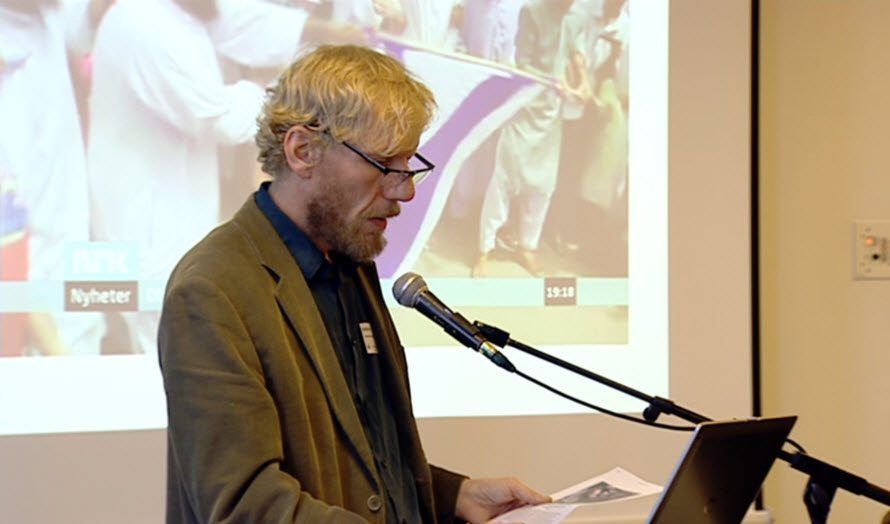
 Slik avsluttet Bjørn Gabrielsen (bildet) sitt korte foredrag da norske medier ble debattert på DMTs seminar tirsdag 14. juni. Gabrielsen er litteraturkritiker og mediekommentator for Dagens Næringsliv. Han har også gitt ut bøker på forlaget Press.
På gaten utenfor synagogen og det jødiske samfunnshuset i Oslo sentrum står store betongklosser som skal hindre at biler med eksplosiver fritt skal kunne bevege seg inntil bygningene.
MIFF publiserer manus til Gabrielsens foredrag, slik det ble fremført på engelsk, se under.
Her er noen av hovedpoengene fra manuset i forkortet form på norsk:
– Norske politikere kan dagdrømme høyt om bombing av Israel, uten at det får konsekvenser.
– Norsk presse gjør svært sjelden et poeng av at en kjendis er jødisk. [Og Gabriesen noterer dette som positivt.]
– Antisemittisme er ikke bare rasisme, det er en konspirasjonsteori om makt. Derfor kan antisemittisme eksistere i en fullstendig upersonlig form, og folk som i utgangspunktet er ikke-rasistiske mennesker, og jøder selv, kan ha betydelig antisemittisk effekt av sine ord eller handlinger.
– Halvparten av verdens jøder bor ikke bare i Israel, men de har, gjennom den parlamentariske prosess, et delt ansvar for det som skjer der. Dersom du tror israelere opptrer på en spesielt umoralsk måte, vil du ende opp med å tro som svært underlige ting om jøder generelt.
– Måten den norske pressen behandler Israel må møtes med noe bekymring. Israel blir nevnt mer enn nesten noe annet land. I 2010, i året før de arabiske revolusjonene, ble Israel nevnt mer enn Tunisia, Algerie, Libya, Egypt, Syria, Jordan og Sudan til sammen. Så det er en skjevhet, allerede der.
– De siste fem årene er Israel nevnt ti til femten ganger flere enn Tsjetsjenia, som igjen er nevnt omkring like ofte som «iskrem».
– Oppmerksomheten som vies Israel har ingenting å gjøre med palestinerne. Da grensen i Rafah mellom Egypt og Gaza ble åpnet i forrige uke, ble det feiret i den norske pressen med helsides fargebilder. Da Egypt og Hamas stengte grensen to dager senere: Ikke et ord. Det palestinske nyhetsbyrået Ma’an rapporterte i forrige uke at fjorten palestinere ble drept i Damaskus, av andre palestinere. Ikke nevnt i den norske pressen. Enhver forbrytelse mot palestinerne gjennomført av andre arabere eller dem selv blir rutinemessig ignorert. 450.000 palestinere mistet sitt hjem i 1991 da Kuwait kastet dem ut. Ingen norsk interesse.
– Oppmerksomheten mot Israel har ikke noe å gjøre med norsk bistand, selv om vi gir mer bistand til palestinerne enn noen andre. Bare 1,5 prosent av artiklene om Israel eller de palestinske myndighetene nevner en eller flere av de norske organisasjonene som arbeider i området.
– Oppmerksomheten om Israel handler ikke om religion, fordi alle religiøse minoriteter i arabiske land og Iran til sammen, de fleste er ofre for horribel forfølgelse, blir nevnt mindre i løpet av ett år enn palestinerne blir nevnt på en måned.
– Det er grunn til å merke seg at Israel er et trygt og behagelig land for selv den mest kritiske journalist.
– Norske medier viste en oppsiktsvekkende likegyldighet til europeiske og norske jøder etter Holocaust. Aftenposten og VG nevnte Mavi Marmara oftere i løpet av to måneder ifjor enn de nevnte utryddelsen av jøder i de første ti årene etter andre verdenskrig. Mens det var noe sympati med Israel i noen deler av norsk samfunnsliv, var det aldri noe i nærheten av lignende entusiasme som det nå er for palestinernes sak.
– Norsk presse dekker krigshandlinger i et etablert mønster, hvor Israel som regel blir framstilt som agent når bomber eksploderer i Gaza («Israel bomber Gaza»), mens bomber som eksploderer i Israel som regel ikke har noen agent («bomben ble utløst»). Dette styrker grunnfortellingen om passive arabere som eventuelt reagerer, og av israelere som er aggressive og aktive.
Bjørn Gabrielsen’s manuscript to lecture 14 June 2011
Some weeks ago an obscure, small town politician posted an update on her Facebook profile concerning the Eurovision Song Contest, saying she would rather see Norway represented by a polar bear or a musk ox than the young black woman who, at the time, was Norway’s candidate.
This caused a storm, 71 different newspaper items, including front pages. She was completely slammed, and rightly so, it was a moronic comment. She was later ditched as the Conservative party’s candidate for mayor in her home town.
Some time earlier a more prominent politician, deputy minister Ingrid Fiskaa of the Socialist Left, confessed in a newspaper interview to daydreaming «in her darkest moments» of the UN bombing Israel. This led to no reaction. No letters to the editor, nothing.
So an uncharitable observer might be led to conclude that Norway is a country where expressing a preference for a polar bear over a black woman in a song contest is considered more of an affront than wanting to bomb Israel.
But how do you know if this is representative of anything? How can you know I’m not cherry-picking anecdotes to fit my own narrative?
One way of finding out is by performing a quantitative analysis of what the Norwegian press actually writes. It’s not a fool-proof method, but it’s better than sitting around and just emoting.
And there is some good news. Some of you might have heard Aftenposten recently had a headline that said «Rich Jews threaten Obama». This was an anomaly, the expression «rich jew» has almost never occurred in the Norwegian press. (I’ve checked.) In general, the Norwegian press is pretty oblivious to whether people are Jewish or not. Dominique Strauss-Kahn, Khodorkovsky, Abramovich, Jon Stewart, Natalie Portman: Only one or two percent of the pieces about them mention their heritage. And it’s pretty much the same whether they’re considered crooks or a role model.
Except, to be honest, in Bernie Madoffs case. He scores ten percent.
This indifference to if somebody is Jewish or not is pretty consistent with the outrage at the politician who didn’t want Norway represented by a black woman in the song contest. Defining an individual by race or heritage is not considered acceptable, at least not in public discourse. This also explains why Norwegians are so flabbergastered when somebody suggests Norway or Norwegian press is anti-Semitic. These Norwegians aren’t play-acting, their genuinely surprised.
But what’s up with the road blocks outside?
And what was that before, about bombing Israel?
This is where it starts to hurt. Anti-Semitism shares some characteristics with other kinds of racism, but it is not only racism. It’s a conspiracy theory about power. Even the most ardent, committed klansman does not believe that blacks control world finance.
Even the staunchest Norwegian opponent of immigration does not believe that Pakistanis and Somalis control the Norwegian media. This kind of racism is intensely personal, it’s about who you want to eat with, who you want your daughter to date. Anti-Semitism, however, can be completely non-personal. Which explains completely insane things like why there’s anti- Semitism in Japan. And this is why supposedly non-racist people and Jews themselves can have such tremendous anti-Semitic impact. They don’t feel racist, so, they believe, they’re home free. And so they say, and believe, almost anything about Israel.
There is certainly a segment of ol’time anti-Semitic cranks out there, as anybody with an internet connection will know. There’s no reason to think they’re all harmless. But in the printed press, anti-Semitism, to the extent it exists, is vocalized through opinions and reporting on Israel.
I realize not all Jews are Israelis and so on. But half of the world’s Jews not only live in Israel, they have, through the parliamentary process, a shared responsibility for what happens there. If you believe Israelis behave in a particularly immoral way, then you’re going to end up believing in some pretty peculiar things about Jews in general.
And the way the Norwegian press deals with Israel should be cause of some concern. To start with, Israel is mentioned more than almost any other country. In 2010, the year leading up to the Arab revolts, Israel was mentioned more often than Tunisia, Algeria, Libya, Egypt, Syria, Jordan and the Sudan put together. So there’s a bias, right there.
That’s pretty much the same all over Europe. There’s no point in being a cry-baby about this. But those who would defend the status quo need to define the motivation for this intense interest in Israel, which clearly comes at an expense. The result, obviously, is extreme indifference for what is going on in the Middle East.
The soaring price of wheat which led to a food crisis in Egypt in 2007 was mentioned once in the Norwegian press. Unemployment soared in Egypt in 2008, but that didn’t warrant a single news item. Ninety percent of Egyptian women have been genitally mutilated, this was mentioned six times in 2010, twice with a positive slant: «Fewer support the practice».
This attention towards Israel is clearly not motivated by violence. Far more serious conflicts are ignored. The last five years Israel has been mentioned ten to fifteen times as often as Chechnya, which in its turn is mentioned about as often as «ice cream.»
This attention to Israel has nothing to do with the Palestinians. When the border at Rafah between Egypt and Gaza opened up last week, this was celebrated in the Norwegian press with full-page color pictures. Then Egypt and Hamas closed the border down two days later: Not a word. The Palestinian news agency Ma’an repored last week that fourteen Palestinians were killed in Damascus, by other Palestinians. Not mentioned in the Norwegian press. Any iniquity visited upon the Palestinians by other Arabs or by themselves, is routinely ignored. 450 000 Palestinians lost their homes in 1991 when Kuwait threw them out. No Norwegian interest.
The attention to Israel has nothing to do with Norwegian aid, though we give more aid to Palestinians than to anybody else. Only one and a half percent of pieces on Israel or the Palestinian Authority mention one more of the Norwegian NGOs who work in the area.
This attention to Israel is not about religion, as all religious minorities in Arab countries and Iran put together, most of whom suffer horrible persecution, are mentioned less in a year than Palestinians are mentioned in a month.
We might want to meditate, at this point, on the fact that Israel is a moderately safe and convenient country for even the most critical journalist.
Tel Aviv, I have been informed, has some rather lovely night clubs.
We might contrast this interest in Israel with the stunning indifference Norwegian media showed towards European and Norwegian Jews after the Holocaust. Aftenposten and VG mentioned «Mavi Marmara» more often in a couple of months last year than they mentioned the extermination of the Jews in the first ten years after World War II. While there was some sympathy with Israel in some quarters of Norwegian life, there was nothing even remotely similar to the current enthusiasm for the Palestinian cause.
A chilling facet of how the Norwegian press covers the Israel/Arab conflict is the established pattern where «Israel bombs Gaza», while bombs in Israel are simply «detonated», without mention of an agent. This use of language is clearly not the result of any conspiracy, journalists are obviously not taught to use active verbs while describing Israeli actions and passive ones when describing Arab actions. Yet, once you start noticing how pervasive this is, you can never again not notice. This can, to a degree, be measured by quantitative analysis, and the results are coherent with the established narrative of passive, reactive Arabs and aggressive, active Israelis.
In conclusion, the Norwegian press employs demonization, delegitimation and double standards to a unique extent when dealing with the country whose government is elected by half of the worlds Jews. There is no case for calling the Norwegian press consciously racist, but nor does offer its readers tools to build resilience against conspiracy theories and anti-Semitism.
Thus, the road blocks outside.